Rabbit Anti-TAS1R3 antibody
TS1R3_HUMAN; Taste receptor type 1 member 3; Sweet taste receptor T1R3; T1R3, TR3;
All categories
View History [Clear]
Details
Product Name TAS1R3 Chinese Name G protein-coupled receptorTAS1R3抗体 Alias TS1R3_HUMAN; Taste receptor type 1 member 3; Sweet taste receptor T1R3; T1R3, TR3; Research Area Cell biology immunology Neurobiology Signal transduction G protein-coupled receptor G protein signal Immunogen Species Rabbit Clonality Polyclonal React Species Human(predicted:Mouse) Applications WB=1:500-2000 (Paraffin sections need antigen repair)
not yet tested in other applications.
optimal dilutions/concentrations should be determined by the end user.Theoretical molecular weight 92kDa Cellular localization The cell membrane Form Liquid Concentration 1mg/ml immunogen KLH conjugated synthetic peptide derived from human TAS1R3: 431-530/852 <Extracellular> Lsotype IgG Purification affinity purified by Protein A Buffer Solution 1M TBS(pH7.4) with 1% BSA, 3% Proclin300 and 50% Glycerol. Storage Shipped at 4℃. Store at -20 °C for one year. Avoid repeated freeze/thaw cycles. Attention This product as supplied is intended for research use only, not for use in human, therapeutic or diagnostic applications. PubMed PubMed Product Detail The protein encoded by this gene is a G-protein coupled receptor involved in taste responses. The encoded protein can form a heterodimeric receptor with TAS1R1 to elicit the umami taste response, or it can bind with TAS1R2 to form a receptor for the sweet taste response. [provided by RefSeq, Nov 2015]
Function:
Putative taste receptor. TAS1R1/TAS1R3 responds to the umami taste stimulus (the taste of monosodium glutamate). TAS1R2/TAS1R3 recognizes diverse natural and synthetic sweeteners. TAS1R3 is essential for the recognition and response to the disaccharide trehalose (By similarity). Sequence differences within and between species can significantly influence the selectivity and specificity of taste responses.
Subunit:
Forms homodimers or heterodimers with TAS1R1 and TAS1R2.
Subcellular Location:
Cell membrane; Multi-pass membrane protein.
Tissue Specificity:
Expressed in vascular endothelium.
Post-translational modifications:
Phosphorylated by FER and other protein-tyrosine kinases. Phosphorylated at Ser-288 by PAK7/PAK5. Dephosphorylated by PTPRJ.
Similarity:
Belongs to the G-protein coupled receptor 3 family. TAS1R subfamily.
SWISS:
Q7RTX0
Gene ID:
83756
Database links:Entrez Gene: 83756 Human
Omim: 605865 Human
SwissProt: Q7RTX0 Human
Unigene: 74375 Human
Product Picture 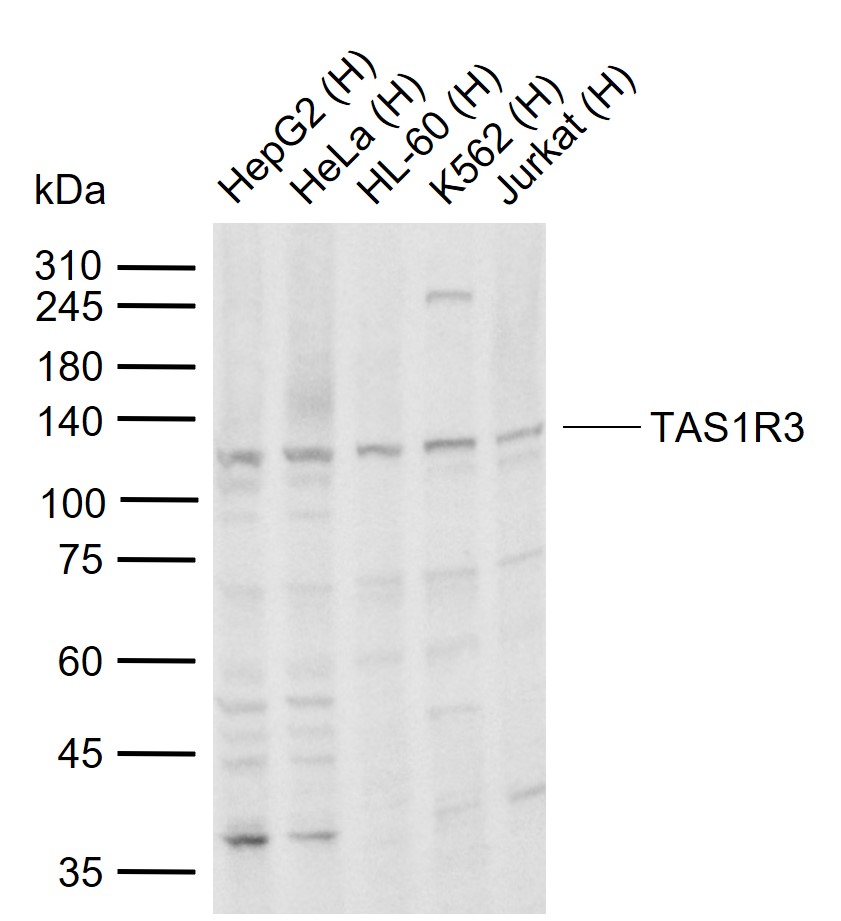 Sample:
Lane 1: Human HepG2 cell lysates
Lane 2: Human HeLa cell lysates
Lane 3: Human HL-60 cell lysates
Lane 4: Human K562 cell lysates
Lane 5: Human Jurkat cell lysates
Primary: Anti-TAS1R3 (SL23618R) at 1/1000 dilution
Secondary: IRDye800CW Goat Anti-Rabbit IgG at 1/20000 dilution
Predicted band size: 92 kDa
Observed band size: 120 kDa
Ordering & shipping
- Minimum order: 1 unit
- Lead time: varies with order quantity and specifications. Please consult your local distributor or our sales team for confirmation
- Payment: T/T 100% in advance; PayPal; Alibaba Trade Assurance
- Shipping: FedEx / DHL / UPS express; cold-chain packing available on request
- Price: USD, per unit (50ul / 100ul)
Partial purchase records(bought amounts latest3)
| Username | Quantity | bought time |
| Iv*** | 1 | 2026-07-07 |
| Fe*** | 1 | 2026-06-02 |
| Da*** | 1 | 2026-01-30 |
User Comment(Total0User Comment Num)
- No comment


 +86 571 56623320

 SUNLONG BIOTECH


